Usually, when I work on a new personal project, like a new version of my own website, I also write an article documenting the process. I can trace this pattern back to 2012, when I wrote about a new version of my website (sorry, the article is in Italian, I was still writing in Italian back then).
It’s funny to read it now. I’m talking about responsiveness, CSS3 animations, using font-face. All things that are absolutely a given today, but were the new thing back then. I continued that tradition on several other occasions, in 2019, 2020, 2021, etc.
The fil rouge was always the same: I would go into the nitty-gritty details of how I solved a specific problem, how I tried a new technology that had become available just a few months earlier, how I fine-tuned every single aspect in order to get a good page speed score on Lighthouse, and things like that.
If you are reading this article around the time of publishing, you are probably reading it on the new version of my website, released in early September 2026. And today I realized that, for the first time in all these years, I haven’t written anything about the process of creating it yet.
I was wondering why, until the explanation suddenly came to me: it’s because I almost didn’t do anything in the process of creating it.
It’s a completely refactored version of the website and still, I didn’t write most of the code. An AI agent did it.
The previous version of this website was created in 2021, and this would have been unthinkable back then. Fast-forward five years and this is the new normal. It would almost feel absurd to do such a big refactor manually when you can now delegate most of the task to a super-efficient virtual assistant that works for you.
And yes, maybe I exaggerated a bit when I said that I didn’t do anything. I had a clear idea of what I wanted, which technology I wanted to use, and how I wanted to structure it. I had seven years of content that I wanted to carry over from the previous versions of this website.
But still, there was no real challenge this time. I mostly observed a machine doing the job, way faster (and arguably better) than I could have ever done it myself.
If you have read my previous articles, you probably know how obsessed I am with getting a high performance score on my websites. So after the first iteration, I was already prepared to check what kind of fine-tuning I might need to do in order to improve the score.
I ran a speed test and saw the following:
Mobile: 100%
Desktop: 100%
Accessibility: 100%
Best Practices: 100%
SEO: 100%
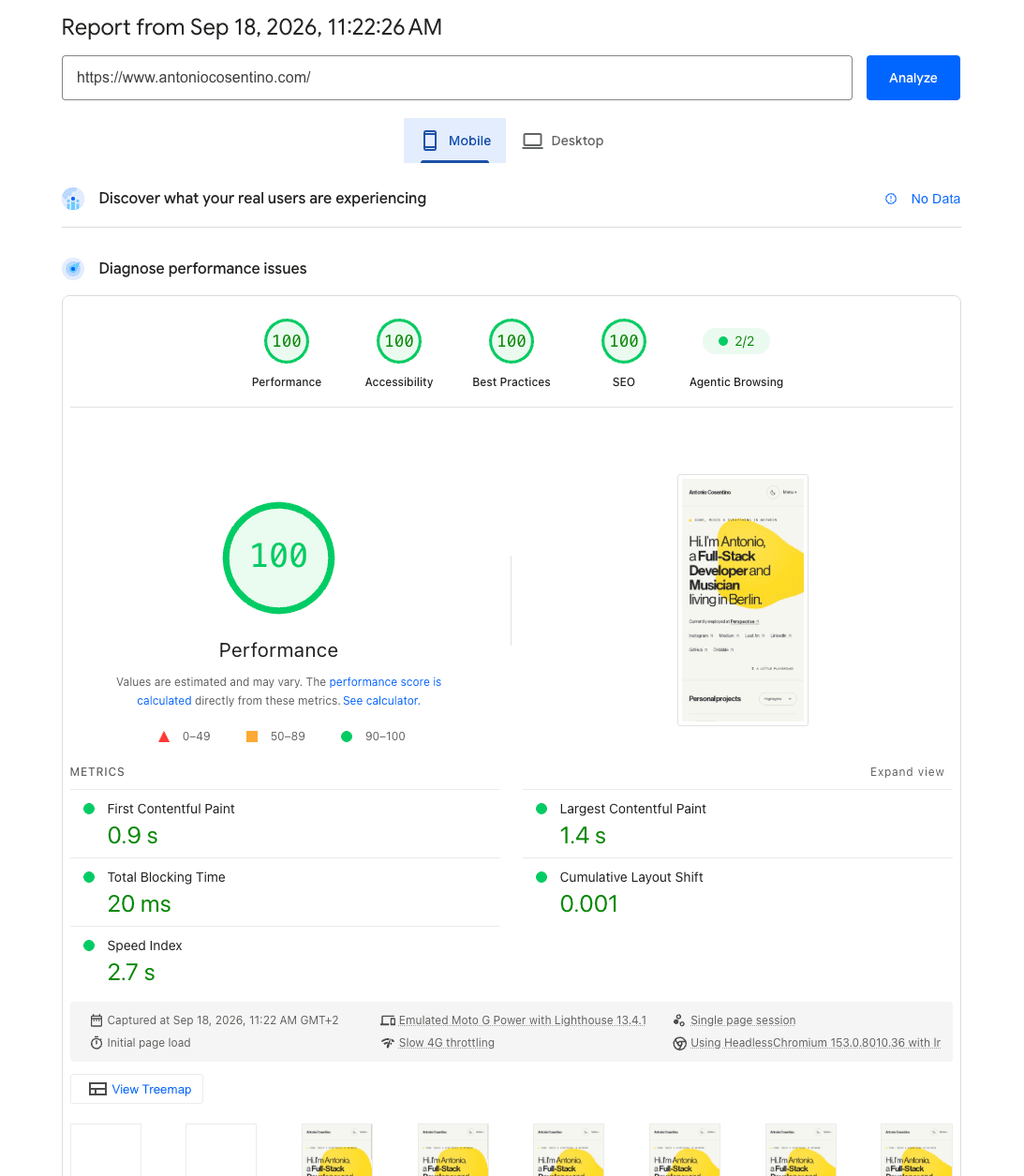
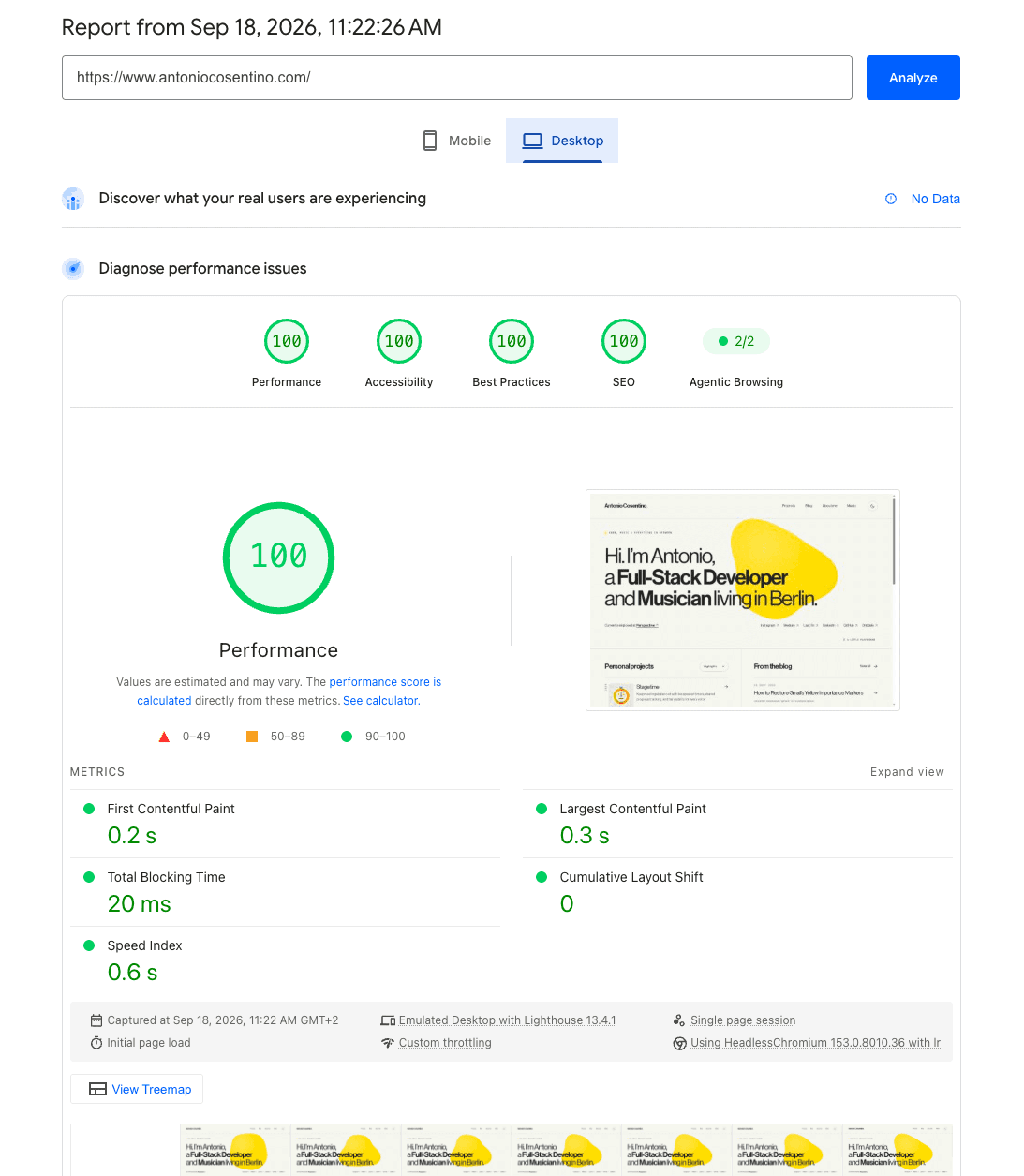
I basically got the best possible results on the first attempt, without having to touch anything else.
This is obviously exciting, but at the same time, a little sad. For people like me who have been doing this job for so long, it can feel like our craft is being taken away.
As Thorsten Ball said in this article (which, by the way, I really recommend reading):
Yes, there are still Italian shoe makers around. But look at your feet.
Everything has changed, and there’s nothing else we can do other than adapt.
Does this remove the joy from building?
Maybe a little bit.
Staying awake until 2 AM browsing Stack Overflow and trying to fix a nasty bug was not fun. But the reward when you finally managed to solve that bug was huge. Now it feels like everything has flattened. Everything just works (most of the time) with minimal effort.
So where’s the challenge now?
I ask myself this very often. The challenge now is probably to have good ideas. To understand what users need, what the software needs, and how to ship brilliant solutions. The obstacle is not the code anymore, so more than ever, creativity becomes the real value.
And maybe this is simply the next evolution of the craft.
In 2012, I was excited about being able to animate something with CSS instead of JavaScript. A few years later, those things had become so ordinary that they weren’t worth writing about anymore. The interesting problems moved somewhere else.
Maybe the same thing is happening now, just on a much bigger scale.
I don’t think I’ll miss spending hours trying to figure out why something is three pixels off, or digging through Stack Overflow hoping that someone had the exact same obscure problem as me in 2014. But I might miss the feeling of finally solving it.
At the same time, having fewer technical obstacles means having more time to focus on what I actually want to build. And that comes with a different kind of responsibility: when almost anyone can build almost anything, what you decide to build matters a lot more than how you build it.
Five years from now, I’ll probably read this article and smile at how much time I spent talking about AI agents, in the same way I now smile at myself talking about CSS3 animations in 2012.
I’m curious to see what will feel obvious by then.